For a man who craves the spotlight as much as President Donald Trump does, the past two weeks must have been hell.
The 45th president, by many reports the most voracious consumer of television news to ever sit behind the Resolute Desk, has spent the days since November 13 in virtual exile from the airwaves as most networks offered gavel-to-gavel coverage of the fourth impeachment inquiry in American history.
Yes, most of the White House press corps still arrived each day to cover Trump's comings and goings while recording even the most prosaic of his utterances. But for the most part, the man who has become accustomed to being the center of attention since January 20, 2017 was shoved aside in favor of a new cast of characters led by Adam Schiff, a California Democrat who has become a go-to hate object for Trump and his supporters.
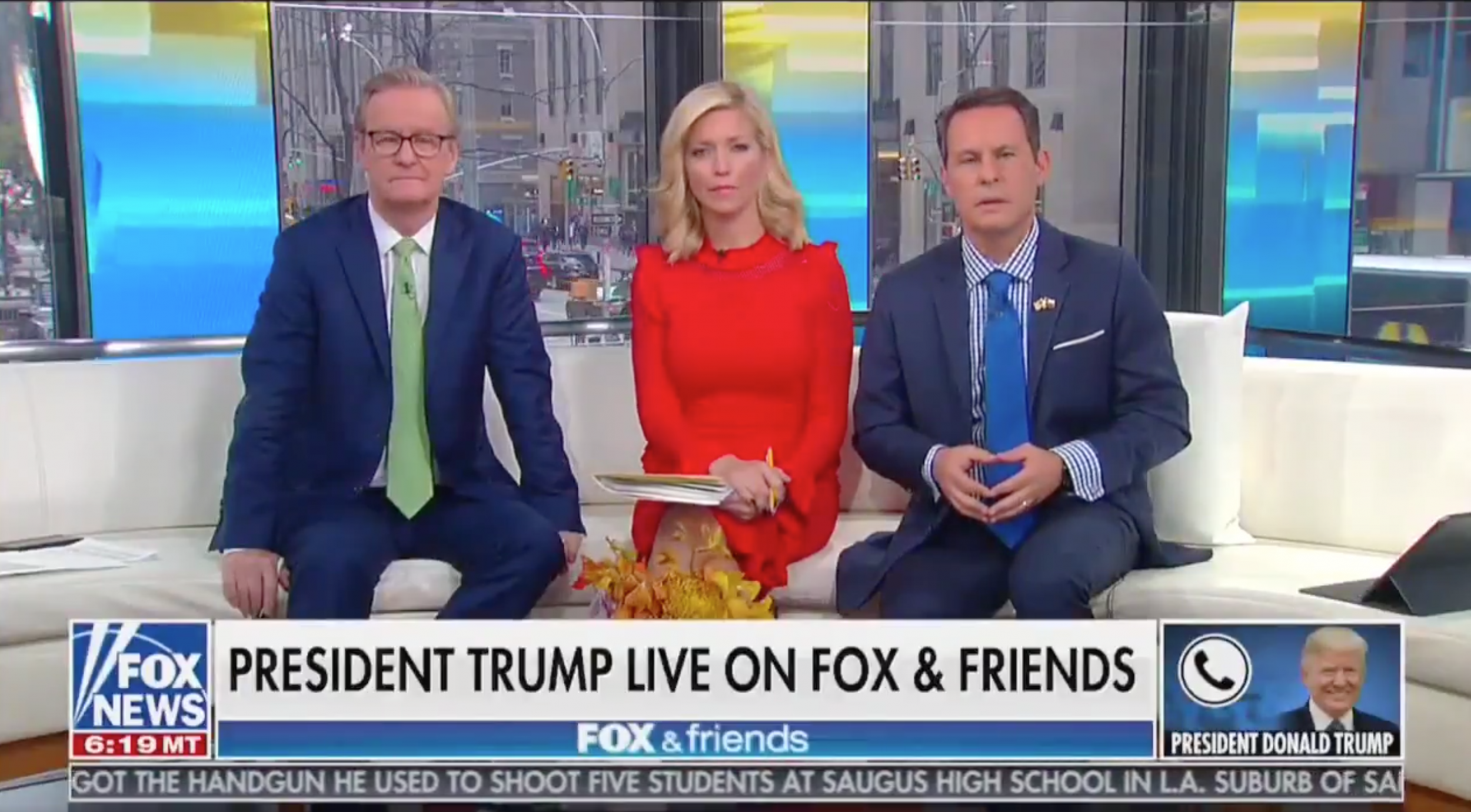
So when Friday finally arrived without an impeachment hearing to capture anyone's attention, Trump decided to air the grievances he'd been nursing for past 10 days, with — as the Beatles put it — a little help from his [Fox and] Friends.
For just under an hour, whatever dam that had held back the presidential logorrhea that had accumulated while most eyes were trained on the Capitol broke with spectacular results.
And as the faces on hosts Steve Doocy, Ainsley Earhardt and Brian Kilmeade vacillated from excited to fascinated to very concerned, Trump spewed forth some of the same conspiracies that a succession of witnesses had debunked at the other end of Pennsylvania Avenue.
From his baseless claim that former President Barack Obama had wiretapped him to the equally baseless claim that Ukraine — not Russia — interfered in the 2016 election and there’s a server secreted away in the former Soviet republic which can prove it, it was a parade of Trump's favorite fever dreams.
He even threw in some self-incrimination for good measure by directly tying his attempt to withhold $391 million in military aid to Ukraine to his desire for Ukrainian President Volodymyr Zelensky's government to investigate that non-existence server. He then admitted — for the second time — that he'd fired former FBI Director James Comey to stave off an investigation into him.
For Republican strategist Rick Wilson, Trump's behavior came as no surprise.
"This is classic Trump behavior — whenever he's almost out of trouble, he does something that puts him back in trouble. The stupidity is strong with this one," said Wilson, who is the author of Everything Trump Touches Dies and the forthcoming Running Against the Devil: A Plot to Save America from Trump — and Democrats.
That Trump would engage in such self-defeating behavior is evidence of both his lack of intellectual means and lack of competent advisers, Wilson said, adding that the president "is not a terribly bright man."
“He has terrible judgment, and if he had real lawyers they would've hit him with a cattle-prod before they let him do that interview," he said.
1/22 Donald Trump
Accused of abusing his office by pressing the Ukrainian president in a July phone call to help dig up dirt on Joe Biden, who may be his Democratic rival in the 2020 election. He also believes that Hillary Clinton’s deleted emails - a key factor in the 2016 election - may be in Ukraine, although it is not clear why.
Reuters
2/22 The Whistleblower
Believed to be a CIA agent who spent time at the White House, his complaint was largely based on second and third-hand accounts from worried White House staff. Although this is not unusual for such complaints, Trump and his supporters have seized on it to imply that his information is not reliable. Expected to give evidence to Congress voluntarily and in secret.
Getty
3/22 The Second Whistleblower
The lawyer for the first intelligence whistleblower is also representing a second whistleblower regarding the President's actions. Attorney Mark Zaid said that he and other lawyers on his team are now representing the second person, who is said to work in the intelligence community and has first-hand knowledge that supports claims made by the first whistleblower and has spoken to the intelligence community's inspector general. The second whistleblower has not yet filed their own complaint, but does not need to to be considered an official whistleblower.
Getty
4/22 Rudy Giuliani
Former mayor of New York, whose management of the aftermath of the September 11 attacks in 2001 won him worldwide praise. As Trump’s personal attorney he has been trying to find compromising material about the president’s enemies in Ukraine in what some have termed a “shadow” foreign policy. In a series of eccentric TV appearances he has claimed that the US state department asked him to get involved. Giuliani insists that he is fighting corruption on Trump’s behalf and has called himself a “hero”.
AP
5/22 Volodymyr Zelensky
The newly elected Ukrainian president - a former comic actor best known for playing a man who becomes president by accident - is seen frantically agreeing with Trump in the partial transcript of their July phone call released by the White House. With a Russian-backed insurgency in the east of his country, and the Crimea region seized by Vladimir Putin in 2014, Zelensky will have been eager to please his American counterpart, who had suspended vital military aid before their phone conversation. He says there was no pressure on him from Trump to do him the “favour” he was asked for. Zelensky appeared at an awkward press conference with Trump in New York during the United Nations general assembly, looking particularly uncomfortable when the American suggested he take part in talks with Putin.
AFP/Getty
6/22 Mike Pence
The vice-president was not on the controversial July call to the Ukrainian president but did get a read-out later. However, Trump announced that Pence had had “one or two” phone conversations of a similar nature, dragging him into the crisis. Pence himself denies any knowledge of any wrongdoing and has insisted that there is no issue with Trump’s actions. It has been speculated that Trump involved Pence as an insurance policy - if both are removed from power the presidency would go to Democratic House Speaker Nancy Pelosi, something no Republican would allow.
AP
7/22 Rick Perry
Trump reportedly told a meeting of Republicans that he made the controversial call to the Ukrainian president at the urging of his own energy secretary, Rick Perry, and that he didn’t even want to. The president apparently said that Perry wanted him to talk about liquefied natural gas - although there is no mention of it in the partial transcript of the phone call released by the White House. It is thought that Perry will step down from his role at the end of the year.
Getty
8/22 Joe Biden
The former vice-president is one of the frontrunners to win the Democratic nomination, which would make him Trump’s opponent in the 2020 election. Trump says that Biden pressured Ukraine to sack a prosecutor who was investigating an energy company that Biden’s son Hunter was on the board of, refusing to release US aid until this was done. However, pressure to fire the prosecutor came on a wide front from western countries. It is also believed that the investigation into the company, Burisma, had long been dormant.
Reuters
9/22 Hunter Biden
Joe Biden’s son has been accused of corruption by the president because of his business dealings in Ukraine and China. However, Trump has yet to produce any evidence of corruption and Biden’s lawyer insists he has done nothing wrong.
AP
10/22 William Barr
The attorney-general, who proved his loyalty to Trump with his handling of the Mueller report, was mentioned in the Ukraine call as someone president Volodymyr Zelensky should talk to about following up Trump’s preoccupations with the Biden’s and the Clinton emails. Nancy Pelosi has accused Barr of being part of a “cover-up of a cover-up”.
AP
11/22 Mike Pompeo
The secretary of state initially implied he knew little about the Ukraine phone call - but it later emerged that he was listening in at the time. He has since suggested that asking foreign leaders for favours is simply how international politics works.
AFP via Getty
12/22 Nancy Pelosi
The Democratic Speaker of the House had long resisted calls from within her own party to back a formal impeachment process against the president, apparently fearing a backlash from voters. On September 24, amid reports of the Ukraine call and the day before the White House released a partial transcript of it, she relented and announced an inquiry, saying: “The president must be held accountable. No one is above the law.”
Getty
13/22 Adam Schiff
Democratic chairman of the House intelligence committee, one of the three committees leading the inquiry. He was criticized by Republicans for giving what he called a “parody” of the Ukraine phone call during a hearing, with Trump and others saying he had been pretending that his damning characterisation was a verbatim reading of the phone call. He has also been criticised for claiming that his committee had had no contact with the whistleblower, only for it to emerge that the intelligence agent had contacted a staff member on the committee for guidance before filing the complaint. The Washington Post awarded Schiff a “four Pinocchios” rating, its worst rating for a dishonest statement.
Reuters
14/22 Lev Parnas and Igor Fruman
Florida-based businessmen and Republican donors Lev Parnas (pictured with Rudy Giuliani) and Igor Fruman were arrested on suspicion of campaign finance violations at Dulles International Airport near Washington DC on 9 October. Separately the Associated Press has reported that they were both involved in efforts to replace the management of Ukraine's gas company, Naftogaz, with new bosses who would steer lucrative contracts towards companies controlled by Trump allies. There is no suggestion of any criminal activity in these efforts.
Reuters
15/22 Kurt Volker
The former US ambassador to NATO was appointed special envoy to Ukraine, and is thought to have played a role in linking Giuliani with Ukraine officials. He resigned just before giving evidence to Congress, which had subpoenaed him. After his testimony it emerged that he had apparently told Giuliani that he was being fed false information about the Bidens from Ukrainian officials.
Getty Images
16/22 Marie Yovanovitch
A career diplomat who was appointed US ambassador to Ukraine towards the end of Barack Obama’s presidency. She was abruptly recalled from her post in May 2019 amid claims that she was not co-operating with Rudy Giuliani’s unorthodox activities in Ukraine. In the Ukraine phone call Trump refers to her as “the woman” and “bad news” and hints darkly at some sort of retribution, saying: “Well, she’s going to go through some things.” Yovanovitch told House investigators in October that she felt as though she were targeted by a false accusations from Giuliani and his associates, who allegedly viewed her as a threat to their political and financial interests. She also said that State Department officials had told her she did nothing wrong, and that her abrupt removal was not related to her performance. Trump had simply lost faith in her abilities. Expected to testify publicly before House committee on 15 November.
AP
17/22 Gordon Sondland
A Seattle hotelier who became US ambassador to the European Union after donating $1 million to Trump’s inauguration committee, despite having no diplomatic experience. According to the whistleblower, Sondland met Ukrainian politicians to help them “understand and respond to the differing messages they were receiving from official US channels on one hand and from Mr GIuliani on the other”. Sondland told House investigators during October 2019 testimony that he had been disappointed with Trump's decision to involve his personal lawyer in dealings with Kiev — and stated that the president refused counsel from his top diplomats, and demanded Volodymyr Zelensky satisfy his concerns about corruption. Those diplomats had told Trump to meet with Zelensky without preconditions, according to Sondland. His testimony is at odds with the testimony of some other foreign policy officials, however, who indicated that Sondland was a willing participant.
Reuters
18/22 George Kent
A career diplomat, he was number two at the Ukraine embassy under Marie Yovanovitch. Kent testified before House investigators in October 2019 that he was cut out of Ukraine policymaking after a May meeting orchestrated by acting chief of staff Mick Mulvaney, and was told to "lay low". The deputy assistant secretary in the Bureau of European and Eurasian Affairs said that he though it was "wrong" that he was sidelines by Trump's inner circle. Following the May meeting, Kent said he was edged out by Gordon Sondland, Kurt Volker, and Rick Perry, who "declared themselves the three people now responsible for Ukraine policy", according to a politician who attended the closed door testimony. Expected to testify publicly to House committee on 12 November.
AFP via Getty Images
19/22 Ulrich Brechbuhl
An adviser to secretary of state Mike Pompeo, with whom he has run businesses. The two were also at West Point military academy together. Swiss-born Brechbuhl is said to handle “special diplomatic assignments”. Subpoenaed to give evidence to Congress in November.
US State Department
20/22 Philip Reeker
Philip Reeker, the acting assistant secretary of State, testified that he did not find out about a push by the Trump administration to force Ukraine to publicly announce an investigation into former vice president Joe Biden until the whistleblower complaint was made public. While he was asked about any quid pro quo in that regard, Reeker indicated he was in the dark and so could not provide further details. But, he did fill in details during his October 2019 testimony on the circumstances surrounding the firing of Marie Yovanovitch. Democrats described his testimony has providing further backup to other testimony they had heard.
AP
21/22 William Taylor
William Taylor, the top US diplomat to Ukraine, testified during an October 2019 hearing in the house that American aid to Ukraine was explicitly tied to the country's willingness to investigate Donald Trump's political rival. Taylor's testimony was explosive, and made him a key witness to the Trump administration's efforts to use the force of the American government to push a politically motivated investigation against Joe Biden. He said the efforts came through an "irregular, informal channel of US policy-making" led by Rudy Giuliani, Kurt Volker, Rick Perry, and Gordon Sondland. Expected to publicly testify before House committee on 13 November.
AP
22/22 Alexander Vindman
Lietenant colonel Alexander Vindman is a top Ukraine expert on the National Security Council, and a decorated Iraq war veteran. He planned to tell the House impeachment inquiry that he heard Donald Trump appeal to Ukraine's president to investigate his leading political rivals. Mr Vindman said he considered the request so damaging to American interests that he reported it to a superior — twice. He is the first person to testify before the House impeachment inquiry who actually listened in on the 25 July phone call, in which Trump urged Volodymyr Zelensky to start an investigation into Joe Biden.
Getty Images
1/22 Donald Trump
Accused of abusing his office by pressing the Ukrainian president in a July phone call to help dig up dirt on Joe Biden, who may be his Democratic rival in the 2020 election. He also believes that Hillary Clinton’s deleted emails - a key factor in the 2016 election - may be in Ukraine, although it is not clear why.
Reuters
2/22 The Whistleblower
Believed to be a CIA agent who spent time at the White House, his complaint was largely based on second and third-hand accounts from worried White House staff. Although this is not unusual for such complaints, Trump and his supporters have seized on it to imply that his information is not reliable. Expected to give evidence to Congress voluntarily and in secret.
Getty
3/22 The Second Whistleblower
The lawyer for the first intelligence whistleblower is also representing a second whistleblower regarding the President's actions. Attorney Mark Zaid said that he and other lawyers on his team are now representing the second person, who is said to work in the intelligence community and has first-hand knowledge that supports claims made by the first whistleblower and has spoken to the intelligence community's inspector general. The second whistleblower has not yet filed their own complaint, but does not need to to be considered an official whistleblower.
Getty
4/22 Rudy Giuliani
Former mayor of New York, whose management of the aftermath of the September 11 attacks in 2001 won him worldwide praise. As Trump’s personal attorney he has been trying to find compromising material about the president’s enemies in Ukraine in what some have termed a “shadow” foreign policy. In a series of eccentric TV appearances he has claimed that the US state department asked him to get involved. Giuliani insists that he is fighting corruption on Trump’s behalf and has called himself a “hero”.
AP
5/22 Volodymyr Zelensky
The newly elected Ukrainian president - a former comic actor best known for playing a man who becomes president by accident - is seen frantically agreeing with Trump in the partial transcript of their July phone call released by the White House. With a Russian-backed insurgency in the east of his country, and the Crimea region seized by Vladimir Putin in 2014, Zelensky will have been eager to please his American counterpart, who had suspended vital military aid before their phone conversation. He says there was no pressure on him from Trump to do him the “favour” he was asked for. Zelensky appeared at an awkward press conference with Trump in New York during the United Nations general assembly, looking particularly uncomfortable when the American suggested he take part in talks with Putin.
AFP/Getty
6/22 Mike Pence
The vice-president was not on the controversial July call to the Ukrainian president but did get a read-out later. However, Trump announced that Pence had had “one or two” phone conversations of a similar nature, dragging him into the crisis. Pence himself denies any knowledge of any wrongdoing and has insisted that there is no issue with Trump’s actions. It has been speculated that Trump involved Pence as an insurance policy - if both are removed from power the presidency would go to Democratic House Speaker Nancy Pelosi, something no Republican would allow.
AP
7/22 Rick Perry
Trump reportedly told a meeting of Republicans that he made the controversial call to the Ukrainian president at the urging of his own energy secretary, Rick Perry, and that he didn’t even want to. The president apparently said that Perry wanted him to talk about liquefied natural gas - although there is no mention of it in the partial transcript of the phone call released by the White House. It is thought that Perry will step down from his role at the end of the year.
Getty
8/22 Joe Biden
The former vice-president is one of the frontrunners to win the Democratic nomination, which would make him Trump’s opponent in the 2020 election. Trump says that Biden pressured Ukraine to sack a prosecutor who was investigating an energy company that Biden’s son Hunter was on the board of, refusing to release US aid until this was done. However, pressure to fire the prosecutor came on a wide front from western countries. It is also believed that the investigation into the company, Burisma, had long been dormant.
Reuters
9/22 Hunter Biden
Joe Biden’s son has been accused of corruption by the president because of his business dealings in Ukraine and China. However, Trump has yet to produce any evidence of corruption and Biden’s lawyer insists he has done nothing wrong.
AP
10/22 William Barr
The attorney-general, who proved his loyalty to Trump with his handling of the Mueller report, was mentioned in the Ukraine call as someone president Volodymyr Zelensky should talk to about following up Trump’s preoccupations with the Biden’s and the Clinton emails. Nancy Pelosi has accused Barr of being part of a “cover-up of a cover-up”.
AP
11/22 Mike Pompeo
The secretary of state initially implied he knew little about the Ukraine phone call - but it later emerged that he was listening in at the time. He has since suggested that asking foreign leaders for favours is simply how international politics works.
AFP via Getty
12/22 Nancy Pelosi
The Democratic Speaker of the House had long resisted calls from within her own party to back a formal impeachment process against the president, apparently fearing a backlash from voters. On September 24, amid reports of the Ukraine call and the day before the White House released a partial transcript of it, she relented and announced an inquiry, saying: “The president must be held accountable. No one is above the law.”
Getty
13/22 Adam Schiff
Democratic chairman of the House intelligence committee, one of the three committees leading the inquiry. He was criticized by Republicans for giving what he called a “parody” of the Ukraine phone call during a hearing, with Trump and others saying he had been pretending that his damning characterisation was a verbatim reading of the phone call. He has also been criticised for claiming that his committee had had no contact with the whistleblower, only for it to emerge that the intelligence agent had contacted a staff member on the committee for guidance before filing the complaint. The Washington Post awarded Schiff a “four Pinocchios” rating, its worst rating for a dishonest statement.
Reuters
14/22 Lev Parnas and Igor Fruman
Florida-based businessmen and Republican donors Lev Parnas (pictured with Rudy Giuliani) and Igor Fruman were arrested on suspicion of campaign finance violations at Dulles International Airport near Washington DC on 9 October. Separately the Associated Press has reported that they were both involved in efforts to replace the management of Ukraine's gas company, Naftogaz, with new bosses who would steer lucrative contracts towards companies controlled by Trump allies. There is no suggestion of any criminal activity in these efforts.
Reuters
15/22 Kurt Volker
The former US ambassador to NATO was appointed special envoy to Ukraine, and is thought to have played a role in linking Giuliani with Ukraine officials. He resigned just before giving evidence to Congress, which had subpoenaed him. After his testimony it emerged that he had apparently told Giuliani that he was being fed false information about the Bidens from Ukrainian officials.
Getty Images
16/22 Marie Yovanovitch
A career diplomat who was appointed US ambassador to Ukraine towards the end of Barack Obama’s presidency. She was abruptly recalled from her post in May 2019 amid claims that she was not co-operating with Rudy Giuliani’s unorthodox activities in Ukraine. In the Ukraine phone call Trump refers to her as “the woman” and “bad news” and hints darkly at some sort of retribution, saying: “Well, she’s going to go through some things.” Yovanovitch told House investigators in October that she felt as though she were targeted by a false accusations from Giuliani and his associates, who allegedly viewed her as a threat to their political and financial interests. She also said that State Department officials had told her she did nothing wrong, and that her abrupt removal was not related to her performance. Trump had simply lost faith in her abilities. Expected to testify publicly before House committee on 15 November.
AP
17/22 Gordon Sondland
A Seattle hotelier who became US ambassador to the European Union after donating $1 million to Trump’s inauguration committee, despite having no diplomatic experience. According to the whistleblower, Sondland met Ukrainian politicians to help them “understand and respond to the differing messages they were receiving from official US channels on one hand and from Mr GIuliani on the other”. Sondland told House investigators during October 2019 testimony that he had been disappointed with Trump's decision to involve his personal lawyer in dealings with Kiev — and stated that the president refused counsel from his top diplomats, and demanded Volodymyr Zelensky satisfy his concerns about corruption. Those diplomats had told Trump to meet with Zelensky without preconditions, according to Sondland. His testimony is at odds with the testimony of some other foreign policy officials, however, who indicated that Sondland was a willing participant.
Reuters
18/22 George Kent
A career diplomat, he was number two at the Ukraine embassy under Marie Yovanovitch. Kent testified before House investigators in October 2019 that he was cut out of Ukraine policymaking after a May meeting orchestrated by acting chief of staff Mick Mulvaney, and was told to "lay low". The deputy assistant secretary in the Bureau of European and Eurasian Affairs said that he though it was "wrong" that he was sidelines by Trump's inner circle. Following the May meeting, Kent said he was edged out by Gordon Sondland, Kurt Volker, and Rick Perry, who "declared themselves the three people now responsible for Ukraine policy", according to a politician who attended the closed door testimony. Expected to testify publicly to House committee on 12 November.
AFP via Getty Images
19/22 Ulrich Brechbuhl
An adviser to secretary of state Mike Pompeo, with whom he has run businesses. The two were also at West Point military academy together. Swiss-born Brechbuhl is said to handle “special diplomatic assignments”. Subpoenaed to give evidence to Congress in November.
US State Department
20/22 Philip Reeker
Philip Reeker, the acting assistant secretary of State, testified that he did not find out about a push by the Trump administration to force Ukraine to publicly announce an investigation into former vice president Joe Biden until the whistleblower complaint was made public. While he was asked about any quid pro quo in that regard, Reeker indicated he was in the dark and so could not provide further details. But, he did fill in details during his October 2019 testimony on the circumstances surrounding the firing of Marie Yovanovitch. Democrats described his testimony has providing further backup to other testimony they had heard.
AP
21/22 William Taylor
William Taylor, the top US diplomat to Ukraine, testified during an October 2019 hearing in the house that American aid to Ukraine was explicitly tied to the country's willingness to investigate Donald Trump's political rival. Taylor's testimony was explosive, and made him a key witness to the Trump administration's efforts to use the force of the American government to push a politically motivated investigation against Joe Biden. He said the efforts came through an "irregular, informal channel of US policy-making" led by Rudy Giuliani, Kurt Volker, Rick Perry, and Gordon Sondland. Expected to publicly testify before House committee on 13 November.
AP
22/22 Alexander Vindman
Lietenant colonel Alexander Vindman is a top Ukraine expert on the National Security Council, and a decorated Iraq war veteran. He planned to tell the House impeachment inquiry that he heard Donald Trump appeal to Ukraine's president to investigate his leading political rivals. Mr Vindman said he considered the request so damaging to American interests that he reported it to a superior — twice. He is the first person to testify before the House impeachment inquiry who actually listened in on the 25 July phone call, in which Trump urged Volodymyr Zelensky to start an investigation into Joe Biden.
Getty Images
Trump's declaration that he welcomes an impeachment trial in the Senate — a view reportedly shared by senior adviser and son-in-law Jared Kushner — reflects equally poorly on Kushner as it does his father-and-law, Wilson added.
"Jared's strategic sense is in his ass — he's truly not that smart," he said, but cautioned that Democrats could hand Trump a victory if they move too quickly or give up trying to get more information about Trump's scheme to extort the announcement of investigations into Biden and 2016 conspiracy theories.
"If they buy into the bulls**t reality distortion field and keep the pedal to the metal, they lose," he explained. "They need to bring another round of witnesses, they need to bring [Giuliani associate Lev] Parnas, and they need to go to court to compel the State Department and other agencies to turn over the documents the White House is withholding. If you're in, you stay in the fight...until one guy is down and bleeding.”
Dr Bandy Lee, an assistant clinical professor at the Yale School of Medicine, said the president's morning gab session was "very concerning," but for medical — not political — reasons.
"It's alarming because he always had a paranoid disposition… but he's entering into delusional territory,” said Lee, who is also the president of the World Mental Health Coalition, a group of mental health professionals "who have come together in historically unprecedented ways to offer our consensus view that Donald Trump’s mental state presents a clear and present danger to the nation and the world."
"He has doubled down on conspiracy theories in the past, which seemed to indicate a psychotic spiral which can happen under duress in individuals with his emotional fragility,” Lee continued. She posited that Trump has exhibited similar behavior as part of a "maladaptive coping mechanism" when he has been criticized or challenged in the past, with impeachment being "the ultimate challenge that he has feared."
Specifically, Lee said Trump "has repeatedly show an inability… to conform his thoughts to facts and emerging information," as well as "an inability to consider consequences and not be unduly influenced by impulsivity or their own emotional needs."
"He believes what he needs to believe emotionally and this is very dangerous," she said, adding that his behavior is that of "a person without mental capacity," which she defined as "somebody who has an inability to take in information, process that information, and incorporate that information into their belief system."
Lee heads the Independent Expert Panel Working Group, which she said has "set up an expert panel that is now available for consultation if called upon during the impeachment proceedings”.
But as things now stand, she added that Trump "has failed every criterion of our mental capacity evaluation."
While some have criticized her group as one that is mounting political attacks on the president, Lee said the concerns she and her colleagues have raised are genuine and based on valid observations.
"People try to discredit us by saying we have not examined him, an examination is crucial for diagnosis and treatment, but when assessing dangerous [people] or incapacity… the direct reports by coworkers and close associates are considered far more valuable," she said. "Collateral information is considered far more important for assessing dangerousness or incapacity — many clinicians believe we know far more about Donald Trump than any patient we have ever seen."
Still, whether it is by her group or another one, Lee stressed the need for Trump to be examined by experts who are "non-governmental and apolitical" to determine whether he is fit to serve.
"Because White House doctors are conflicted due to their employment and their status as subordinates to the commander-in-chief, we do not believe that the White House physician would be able to put public interest ahead of following the president's wishes," she said. "That is why we believe an independent expert panel is critical to be able to examine the president for fitness for duty."
from Top stories - Google News https://ift.tt/2qGLGE3
via IFTTT

No comments:
Post a Comment